US economic, military and political dominance is likely to decline over the next two decades, according to a new US intelligence report on global trends.
The National Intelligence Council (NIC) predicts China, India and Russia will increasingly challenge US influence.
It also says the dollar may no longer be the world's major currency, and food and water shortages will fuel conflict.
However, the report concedes that these outcomes are not inevitable and will depend on the actions of world leaders.
It will make sombre reading for President-elect Barack Obama, the BBC's Jonathan Beale in Washington says, as it paints a bleak picture of the future of US influence and power.
The US will remain the single most important actor but will be less dominant
Global Trends 2025
"The next 20 years of transition to a new system are fraught with risks," says Global Trends 2025, the latest of the reports that the NIC prepares every four years in time for the next presidential term.
Washington will retain its considerable military advantages, but scientific and technological advances; the use of "irregular warfare tactics"; the proliferation of long-range precision weapons; and the growing use of cyber warfare "increasingly will constrict US freedom of action", it adds.
Nevertheless, the report concludes: "The US will remain the single most important actor but will be less dominant."
Nuclear weapons use
The NIC's 2004 study painted a rosier picture of America's global position, with US dominance expected to continue.
But the latest Global Trends report says that rising economies such as China, India, Russia and Brazil will offer the US more competition at the top of a multi-polar international system.
Most computers will open this document automatically, but you may need Adobe Reader
Download the reader here
The EU is meanwhile predicted to become a "hobbled giant", unable to turn its economic power into diplomatic or military muscle.
A world with more power centres will be less stable than one with one or two superpowers, it says, offering more potential for conflict.
Global warming, along with rising populations and economic growth will put additional strains on natural resources, it warns, fuelling conflict around the globe as countries compete for them.
"Strategic rivalries are most likely to revolve around trade, investments and technological innovation and acquisition, but we cannot rule out a 19th Century-like scenario of arms races, territorial expansion and military rivalries," the report says.
"Types of conflict we have not seen for a while - such as over resources - could re-emerge."
There will be greater potential for conflict in the future, the NIC says
Such conflicts and resource shortages could lead to the collapse of governments in Africa and South Asia, and the rise of organised crime in Eastern and Central Europe, it adds.
And the use of nuclear weapons will grow increasingly likely, the report says, as "rogue states" and militant groups gain greater access to them.
But al-Qaeda could decay "sooner than people think", it adds, citing the group's growing unpopularity in the Muslim world.
"The prospect that al-Qaeda will be among the small number of groups able to transcend the generational timeline is not high, given its harsh ideology, unachievable strategic objectives and inability to become a mass movement," it says.
The NIC does, however, give some scope for leaders to take action to prevent the emergence of new conflicts.
"It is not beyond the mind of human beings, or political systems, [or] in some cases [the] working of market mechanisms to address and alleviate if not solve these problems," said Thomas Fingar, chairman of the NIC.
And, our correspondent adds, it is worth noting that US intelligence has been wrong before.
Source
Friday, November 21, 2008

Thursday, November 13, 2008
German Doctors Say: Bone Marrow Treatment May Have "Cured" AIDS
An American who suffered from AIDS is said to have been cured of the disease 20 months after receiving a targeted bone marrow transplant normally used to fight leukemia.
While researchers — and the doctors themselves — caution that the case might be no more than a fluke, others say it may inspire a greater interest in gene therapy to fight the disease that claims 2 million lives each year. The virus has infected 33 million people worldwide.
Dr. Gero Huetter said his 42-year-old patient, an American living in Berlin who was not identified, had been infected with the AIDS virus for more than a decade. But 20 months after undergoing a transplant of genetically selected bone marrow, he no longer shows signs of carrying the virus.
"We waited every day for a bad reading," Huetter said.
It has not come. Researchers at Berlin's Charite hospital and medical school say tests on his bone marrow, blood and other organ tissues have all been clean.
However, Dr. Andrew Badley, director of the HIV and immunology research lab at the Mayo Clinic in Rochester, Minn., said those tests have probably not been extensive enough.
"A lot more scrutiny from a lot of different biological samples would be required to say it's not present," Badley said.
This isn't the first time marrow transplants have been attempted for treating AIDS or HIV infection. In 1999, an article in the journal Medical Hypotheses reviewed the results of 32 attempts reported between 1982 and 1996. In two cases, HIV was apparently eradicated, the review reported.
Huetter's patient was under treatment at Charite for both AIDS and leukemia, which developed unrelated to HIV.
As Huetter — who is a hematologist, not an HIV specialist — prepared to treat the patient's leukemia with a bone marrow transplant, he recalled that some people carry a genetic mutation that seems to make them resistant to HIV infection. If the mutation, called Delta 32, is inherited from both parents, it prevents HIV from attaching itself to cells by blocking CCR5, a receptor that acts as a kind of gateway.
"I read it in 1996, coincidentally," Huetter told reporters at the medical school. "I remembered it and thought it might work."
Roughly one in 1,000 Europeans and Americans have inherited the mutation from both parents, and Huetter set out to find one such person among donors that matched the patient's marrow type. Out of a pool of 80 suitable donors, the 61st person tested carried the proper mutation.
Before the transplant, the patient endured powerful drugs and radiation to kill off his own infected bone marrow cells and disable his immune system — a treatment fatal to between 20 and 30 percent of recipients.
He was also taken off the potent drugs used to treat his AIDS. Huetter's team feared that the drugs might interfere with the new marrow cells' survival. They risked lowering his defenses in the hopes that the new, mutated cells would reject the virus on their own.
Anthony Fauci, director of the National Institute of Allergy and Infections Diseases in the U.S., said the procedure was too costly and too dangerous to employ as a firstline cure. But he said it could inspire researchers to pursue gene therapy as a means to block or suppress HIV.
"It helps prove the concept that if somehow you can block the expression of CCR5, maybe by gene therapy, you might be able to inhibit the ability of the virus to replicate," Fauci said.
David Roth, a professor of epidemiology and international public health at the London School of Hygiene and Tropical Medicine, said gene therapy as cheap and effective as current drug treatments is in very early stages of development.
"That's a long way down the line because there may be other negative things that go with that mutation that we don't know about."
Even for the patient in Berlin, the lack of a clear understanding of exactly why his AIDS has disappeared means his future is far from certain.
"The virus is wily," Huetter said. "There could always be a resurgence."
Source
While researchers — and the doctors themselves — caution that the case might be no more than a fluke, others say it may inspire a greater interest in gene therapy to fight the disease that claims 2 million lives each year. The virus has infected 33 million people worldwide.
Dr. Gero Huetter said his 42-year-old patient, an American living in Berlin who was not identified, had been infected with the AIDS virus for more than a decade. But 20 months after undergoing a transplant of genetically selected bone marrow, he no longer shows signs of carrying the virus.
"We waited every day for a bad reading," Huetter said.
It has not come. Researchers at Berlin's Charite hospital and medical school say tests on his bone marrow, blood and other organ tissues have all been clean.
However, Dr. Andrew Badley, director of the HIV and immunology research lab at the Mayo Clinic in Rochester, Minn., said those tests have probably not been extensive enough.
"A lot more scrutiny from a lot of different biological samples would be required to say it's not present," Badley said.
This isn't the first time marrow transplants have been attempted for treating AIDS or HIV infection. In 1999, an article in the journal Medical Hypotheses reviewed the results of 32 attempts reported between 1982 and 1996. In two cases, HIV was apparently eradicated, the review reported.
Huetter's patient was under treatment at Charite for both AIDS and leukemia, which developed unrelated to HIV.
As Huetter — who is a hematologist, not an HIV specialist — prepared to treat the patient's leukemia with a bone marrow transplant, he recalled that some people carry a genetic mutation that seems to make them resistant to HIV infection. If the mutation, called Delta 32, is inherited from both parents, it prevents HIV from attaching itself to cells by blocking CCR5, a receptor that acts as a kind of gateway.
"I read it in 1996, coincidentally," Huetter told reporters at the medical school. "I remembered it and thought it might work."
Roughly one in 1,000 Europeans and Americans have inherited the mutation from both parents, and Huetter set out to find one such person among donors that matched the patient's marrow type. Out of a pool of 80 suitable donors, the 61st person tested carried the proper mutation.
Before the transplant, the patient endured powerful drugs and radiation to kill off his own infected bone marrow cells and disable his immune system — a treatment fatal to between 20 and 30 percent of recipients.
He was also taken off the potent drugs used to treat his AIDS. Huetter's team feared that the drugs might interfere with the new marrow cells' survival. They risked lowering his defenses in the hopes that the new, mutated cells would reject the virus on their own.
Anthony Fauci, director of the National Institute of Allergy and Infections Diseases in the U.S., said the procedure was too costly and too dangerous to employ as a firstline cure. But he said it could inspire researchers to pursue gene therapy as a means to block or suppress HIV.
"It helps prove the concept that if somehow you can block the expression of CCR5, maybe by gene therapy, you might be able to inhibit the ability of the virus to replicate," Fauci said.
David Roth, a professor of epidemiology and international public health at the London School of Hygiene and Tropical Medicine, said gene therapy as cheap and effective as current drug treatments is in very early stages of development.
"That's a long way down the line because there may be other negative things that go with that mutation that we don't know about."
Even for the patient in Berlin, the lack of a clear understanding of exactly why his AIDS has disappeared means his future is far from certain.
"The virus is wily," Huetter said. "There could always be a resurgence."
Source
Fake NY Times Declares "IRAQ WAR ENDS"
 A group of liberal pranksters created a fake issue of the New York Times with a wide headline that declares "Iraq War Ends". For those who missed the joke, the realistic-looking paper was dated July 4, 2009, and came with a weather forecast calling for "recent gloom passing ... strong leftward winds."
The Times's City Room blog writes:
In an elaborate hoax, pranksters distributed thousands of free copies of a spoof edition of The New York Times on Wednesday morning at busy subway stations around the city, including Grand Central Terminal, Washington and Union Squares, the 14th and 23rd Street stations along Eighth Avenue, and Pacific Street in Brooklyn, among others.
The spurious 14-page papers — with a headline "IRAQ WAR ENDS" — surprised commuters, many of whom took the free copies thinking they were legitimate.
The paper is dated July 4, 2009, and imagines a liberal utopia of national health care, a rebuilt economy, progressive taxation, a national oil fund to study climate change, and other goals of progressive politics.
The hoax was accompanied by a Web site that mimics the look of The Times’s real Web site. A page of the spoof site contained links to dozens of progressive organizations, which were also listed in the print edition.
Tuesday, November 11, 2008
US Secret Service tags Obama "Renegade"
The US secret service is reported to have assigned president-elect Barack Obama the code name "Renegade".
This is in keeping with a tradition since the second world war of ascribing code names to presidents.
While the White House nor the Obama camp is unlikely to confirm them, such code names are seldom regarded as closely guarded secrets and quickly leak out.
The Chicago Tribune, Obama's hometown paper, reported on its website on Monday night that wife Michelle has been named "Renaissance", and their two daughters, Malia and Sasha, have been given the designations "Radiance" and "Rosebud". It is no coincidence that they all begin with R.
The vice-president-elect, Joe Biden, has his Irish background recognised with the code name "Celtic".
The secret service has said in the past that such names are chosen on a whim. Among previous presidents, John Kennedy, in keeping with the labelling of his White House "Camelot", was named "Lancer", and Reagan "Rawhide".
Source
This is in keeping with a tradition since the second world war of ascribing code names to presidents.
While the White House nor the Obama camp is unlikely to confirm them, such code names are seldom regarded as closely guarded secrets and quickly leak out.
The Chicago Tribune, Obama's hometown paper, reported on its website on Monday night that wife Michelle has been named "Renaissance", and their two daughters, Malia and Sasha, have been given the designations "Radiance" and "Rosebud". It is no coincidence that they all begin with R.
The vice-president-elect, Joe Biden, has his Irish background recognised with the code name "Celtic".
The secret service has said in the past that such names are chosen on a whim. Among previous presidents, John Kennedy, in keeping with the labelling of his White House "Camelot", was named "Lancer", and Reagan "Rawhide".
Source
Monday, November 10, 2008
TIME's Best Inventions of 2008
TIME published its version of Best 50 Inventions of 2008: from a genetic testing service to an invisibility cloak to an ingenious public bike system to the world's first moving skyscraper — here are TIME's picks for the top innovations of 2008
1. The Retail DNA Test

Before meeting with Anne Wojcicki, co-founder of a consumer gene-testing service called 23andMe, I know just three things about her: she's pregnant, she's married to Google's Sergey Brin, and she went to Yale. But after an hour chatting with her in the small office she shares with co-founder Linda Avey at 23andMe's headquarters in Mountain View, Calif., I know some things no Internet search could reveal: coffee makes her giddy, she has a fondness for sequined shoes and fresh-baked bread, and her unborn son has a 50% chance of inheriting a high risk for Parkinson's disease.
Learning and sharing your genetic secrets are at the heart of 23andMe's controversial new service — a $399 saliva test that estimates your predisposition for more than 90 traits and conditions ranging from baldness to blindness. Although 23andMe isn't the only company selling DNA tests to the public, it does the best job of making them accessible and affordable. The 600,000 genetic markers that 23andMe identifies and interprets for each customer are "the digital manifestation of you," says Wojcicki (pronounced Wo-jis-key), 35, who majored in biology and was previously a health-care investor. "It's all this information beyond what you can see in the mirror."
We are at the beginning of a personal-genomics revolution that will transform not only how we take care of ourselves but also what we mean by personal information. In the past, only élite researchers had access to their genetic fingerprints, but now personal genotyping is available to anyone who orders the service online and mails in a spit sample. Not everything about how this information will be used is clear yet — 23andMe has stirred up debate about issues ranging from how meaningful the results are to how to prevent genetic discrimination — but the curtain has been pulled back, and it can never be closed again. And so for pioneering retail genomics, 23andMe's DNA-testing service is Time's 2008 Invention of the Year.
The 1997 film Gattaca depicted it as a futuristic nightmare, but human-genotyping has emerged instead as both a real business and a status symbol. Movie mogul Harvey Weinstein says he is backing 23andMe not for its cinematic possibilities but because "I think it is a good investment. This is strictly medical and business-like." Google has chipped in almost half the $8.9 million in funding raised by the firm, which counts Warren Buffett, Rupert Murdoch and Ivanka Trump among its clients.
Weinstein isn't saying what his test told him, but Wojcicki and her famous husband are perfectly willing to discuss their own genetic flaws. Most worrisome is a rare mutation that gives Brin an estimated 20% to 80% chance of getting Parkinson's disease. There's a 50% chance that the couple's child, due later this year, will inherit that same gene. "I don't find this embarrassing in any way," says Brin, who blogged about it in September. "I felt it was a lot of work and impractical to keep it secret, and I think in 10 years it will be commonplace to learn about your genome."
And yet while Wojcicki and Brin aren't worried about genetic privacy, others are. In May, President George W. Bush signed a bill that makes it illegal for employers and insurers to discriminate on the basis of genetic information. California and New York tried to block the tests on the grounds that they were not properly licensed, but have so far been unsuccessful. Others worry about how sharing one's genetic data might affect close relatives who would prefer not to let a family history of schizophrenia or Lou Gehrig's disease become public. And what if a potential mate demands to see your genome before getting serious? Such hypotheticals are endless. And some researchers argue that the tests are flawed. "The uncertainty is too great," says Dr. Muin Khoury, director of the National Office of Public Health Genomics at the Centers for Disease Control and Prevention, who argues that it is wrong to charge people for access to such preliminary and incomplete data. Many diseases stem from several different genes and are triggered by environmental factors. Since less than a tenth of our 20,000 genes have been correlated with any condition, it's impossible to nail down exactly what component is genetic. "A little knowledge is a dangerous thing," says Dr. Alan Guttmacher of the National Institutes of Health.
23andMe is unfazed by its detractors. "It's somewhat paternalistic to say people shouldn't get these tests because 'we don't want people to misunderstand or get upset,'" says board member Esther Dyson. There can be a psychological upside too: some people decide to lead healthier lifestyles. Brin is currently funding Parkinson's research. And not all customers' results are as troubling as his. Nate Guy, 19, of Warrenton, Va., was relieved that though his uncle had died of prostate cancer, his own risk for the disease was about average. He even posted a video about it on YouTube. And unflattering findings can have a silver lining. "Now I have an excuse for not remembering things, because my memory is probably genetically flawed," Guy says.
Wojcicki and Avey see themselves not just as businesswomen but also as social entrepreneurs. With their customers' consent, they plan to amass everyone's genetic footprint in a giant database that can be mined for clues to which mutations make us susceptible to specific diseases and which drugs people are more likely to respond to. "You're donating your genetic information," says Wojcicki. "We could make great discoveries if we just had more information. We all carry this information, and if we bring it together and democratize it, we could really change health care."
2. The Tesla Roadster

Electric cars were always environmentally friendly, quiet, clean — but definitely not sexy. The Tesla Roadster has changed all that. A battery-powered sports car that sells for $100,000 and has a top speed of 125 m.p.h. (200 km/h), the Roadster has excited the clean-tech crowd since it was announced in 2003. Celebrities like George Clooney joined a long waiting list for the Roadster; magazines like Wired drooled over it. After years of setbacks and shake-ups, the first Tesla Roadsters were delivered to customers this year. Reviews have been ecstatic, but Tesla Motors has been hit hard by the financial crisis. Plans to develop an affordable electric sedan have been put on hold, and Tesla is laying off employees. But even if the Roadster turns out to be a one-hit wonder, it's been a hell of an (electric) ride.
3. The Lunar Reconnaissance Orbiter

It may have been a long time since the U.S. built the world's best cars, but nobody can touch us when it comes to spacecraft. NASA is about to prove that again with the planned launch in February 2009 of the Lunar Reconnaissance Orbiter (lro). Our first unmanned moonship in 11 years, the lro will study the things lunar orbiters always study — gravity, temperature — but it will also look for signs of water ice, a vital resource for any future lunar base, and compile detailed 3-D lunar maps, including all six Apollo landing sites. Wingnuts, be warned: yes, we really went there.
Read the rest of the story here
1. The Retail DNA Test
Before meeting with Anne Wojcicki, co-founder of a consumer gene-testing service called 23andMe, I know just three things about her: she's pregnant, she's married to Google's Sergey Brin, and she went to Yale. But after an hour chatting with her in the small office she shares with co-founder Linda Avey at 23andMe's headquarters in Mountain View, Calif., I know some things no Internet search could reveal: coffee makes her giddy, she has a fondness for sequined shoes and fresh-baked bread, and her unborn son has a 50% chance of inheriting a high risk for Parkinson's disease.
Learning and sharing your genetic secrets are at the heart of 23andMe's controversial new service — a $399 saliva test that estimates your predisposition for more than 90 traits and conditions ranging from baldness to blindness. Although 23andMe isn't the only company selling DNA tests to the public, it does the best job of making them accessible and affordable. The 600,000 genetic markers that 23andMe identifies and interprets for each customer are "the digital manifestation of you," says Wojcicki (pronounced Wo-jis-key), 35, who majored in biology and was previously a health-care investor. "It's all this information beyond what you can see in the mirror."
We are at the beginning of a personal-genomics revolution that will transform not only how we take care of ourselves but also what we mean by personal information. In the past, only élite researchers had access to their genetic fingerprints, but now personal genotyping is available to anyone who orders the service online and mails in a spit sample. Not everything about how this information will be used is clear yet — 23andMe has stirred up debate about issues ranging from how meaningful the results are to how to prevent genetic discrimination — but the curtain has been pulled back, and it can never be closed again. And so for pioneering retail genomics, 23andMe's DNA-testing service is Time's 2008 Invention of the Year.
The 1997 film Gattaca depicted it as a futuristic nightmare, but human-genotyping has emerged instead as both a real business and a status symbol. Movie mogul Harvey Weinstein says he is backing 23andMe not for its cinematic possibilities but because "I think it is a good investment. This is strictly medical and business-like." Google has chipped in almost half the $8.9 million in funding raised by the firm, which counts Warren Buffett, Rupert Murdoch and Ivanka Trump among its clients.
Weinstein isn't saying what his test told him, but Wojcicki and her famous husband are perfectly willing to discuss their own genetic flaws. Most worrisome is a rare mutation that gives Brin an estimated 20% to 80% chance of getting Parkinson's disease. There's a 50% chance that the couple's child, due later this year, will inherit that same gene. "I don't find this embarrassing in any way," says Brin, who blogged about it in September. "I felt it was a lot of work and impractical to keep it secret, and I think in 10 years it will be commonplace to learn about your genome."
And yet while Wojcicki and Brin aren't worried about genetic privacy, others are. In May, President George W. Bush signed a bill that makes it illegal for employers and insurers to discriminate on the basis of genetic information. California and New York tried to block the tests on the grounds that they were not properly licensed, but have so far been unsuccessful. Others worry about how sharing one's genetic data might affect close relatives who would prefer not to let a family history of schizophrenia or Lou Gehrig's disease become public. And what if a potential mate demands to see your genome before getting serious? Such hypotheticals are endless. And some researchers argue that the tests are flawed. "The uncertainty is too great," says Dr. Muin Khoury, director of the National Office of Public Health Genomics at the Centers for Disease Control and Prevention, who argues that it is wrong to charge people for access to such preliminary and incomplete data. Many diseases stem from several different genes and are triggered by environmental factors. Since less than a tenth of our 20,000 genes have been correlated with any condition, it's impossible to nail down exactly what component is genetic. "A little knowledge is a dangerous thing," says Dr. Alan Guttmacher of the National Institutes of Health.
23andMe is unfazed by its detractors. "It's somewhat paternalistic to say people shouldn't get these tests because 'we don't want people to misunderstand or get upset,'" says board member Esther Dyson. There can be a psychological upside too: some people decide to lead healthier lifestyles. Brin is currently funding Parkinson's research. And not all customers' results are as troubling as his. Nate Guy, 19, of Warrenton, Va., was relieved that though his uncle had died of prostate cancer, his own risk for the disease was about average. He even posted a video about it on YouTube. And unflattering findings can have a silver lining. "Now I have an excuse for not remembering things, because my memory is probably genetically flawed," Guy says.
Wojcicki and Avey see themselves not just as businesswomen but also as social entrepreneurs. With their customers' consent, they plan to amass everyone's genetic footprint in a giant database that can be mined for clues to which mutations make us susceptible to specific diseases and which drugs people are more likely to respond to. "You're donating your genetic information," says Wojcicki. "We could make great discoveries if we just had more information. We all carry this information, and if we bring it together and democratize it, we could really change health care."
2. The Tesla Roadster
Electric cars were always environmentally friendly, quiet, clean — but definitely not sexy. The Tesla Roadster has changed all that. A battery-powered sports car that sells for $100,000 and has a top speed of 125 m.p.h. (200 km/h), the Roadster has excited the clean-tech crowd since it was announced in 2003. Celebrities like George Clooney joined a long waiting list for the Roadster; magazines like Wired drooled over it. After years of setbacks and shake-ups, the first Tesla Roadsters were delivered to customers this year. Reviews have been ecstatic, but Tesla Motors has been hit hard by the financial crisis. Plans to develop an affordable electric sedan have been put on hold, and Tesla is laying off employees. But even if the Roadster turns out to be a one-hit wonder, it's been a hell of an (electric) ride.
3. The Lunar Reconnaissance Orbiter
It may have been a long time since the U.S. built the world's best cars, but nobody can touch us when it comes to spacecraft. NASA is about to prove that again with the planned launch in February 2009 of the Lunar Reconnaissance Orbiter (lro). Our first unmanned moonship in 11 years, the lro will study the things lunar orbiters always study — gravity, temperature — but it will also look for signs of water ice, a vital resource for any future lunar base, and compile detailed 3-D lunar maps, including all six Apollo landing sites. Wingnuts, be warned: yes, we really went there.
Read the rest of the story here
Tuesday, November 4, 2008
Barack Obama and John McCain Switch Color of Their Skin
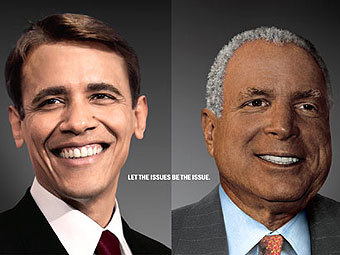 Grey New York, the global ad agency, released an image today reminding voters to "Let the Issues Be the Issue" as they go to the polls on Election Day.
The image features the two senators, Democrat Barack Obama and Republican John McCain, whose hard-fought battle for the White House is drawing to a close, with their skin colors switched.
Tor Myhren, Grey New York's Chief Creative Officer, said, "This is a non-partisan image. We wanted to address the race issue straight on. And it cuts both ways. If you're hopping on either candidate's bandwagon solely due to the color of their skin, you're voting for the wrong reasons."
The image is being run in newspapers, outdoor posters and online.
The image has been picked up by several public high schools in New York, Denver and other cities around the US. A lesson plan has been built around it, and it will be used as a discussion piece with students.
Source
Subscribe to:
Comments (Atom)